September 18, 2026
📞 200 dials → 2 convos · 🤖 21 agents, 3 humans · 📈 3x outbound
Google starts paying publishers for AI answers, MIT counts 11% deep adoption, plus the cleanup tax.
Two hundred cold calls produced twenty hopeful "send me a demo"s and exactly two live conversations — the r/sales comment section did the math, and the verdict is both brutal and normal. Meanwhile SaaStr runs event ops with 21 agents and 3 humans at $257 a month, and MIT's dig through SEC filings found only 11% of the S&P 500 has AI truly embedded. This week: a tripled outbound experiment, the invisible glue work holding AI adoption together, and procurement tactics that protect your price. Let's get into it.
The Outbound Rebuild
AI didn't fix the funnel this week — three experiments did. A tripled outbound test, a hard look at why more AI won't grow revenue, and a SaaS founder who replaced 17 people with 21 agents.
#136: The experiment that TRIPLED our outbound in 1 month (Using AI)
Florin Tatulea's SDR team ran a one-month experiment and tripled its demo rate, booking $1M in pipeline on the way to $2M for the year. The mechanism: agents assemble a daily "context package" that ranks the entire contact universe and drops the 150–400 warmest accounts per segment onto each rep's screen — contact history, intent score, recommended play, generated opener and voicemail, all pulled from the account's own signals. Cold contacts get warmed separately: roughly 5,000 score below the line, sit in a five-step executive sequence with low-friction CTAs instead of meeting asks, and route back to SDRs the moment engagement crosses the threshold. Steal the CTA rule even if you steal nothing else — a demo ask against zero signal converts nothing and burns the contact.
Source: Prospecting from the Trenches (Florin Tatulea)
Why More AI Won't Grow Your Revenue (and What Will)
Loreal Lynch — CMO at Nooks, previously Jasper — argues that bolting more agents onto a pre-AI process is why most revenue teams will end up disappointed. Her iceberg framing: agent work sits below the waterline doing volume, humans stay above for judgment, narrative, and reading the room, and the interesting flip is coming — today reps prompt the AI, soon the AI prompts the rep on who to call next. Teams she cites see roughly 3x meetings and 2x pipeline on the same headcount, which is why she treats this as augmentation: if an agent makes a rep 10x, you hire more reps, not fewer. The unglamorous part is infrastructure — shared data, governance, deliverability — and it's why "agents are easy to build" falls apart at scale.
Source: GTMnow by GTMfund
SaaStr Replaces 17 Humans With 21 AI Agents
Growth Glider distilled 403 minutes across eight podcast episodes into one operating story: SaaStr now runs event operations with 21 agents and 3 humans, down from 20 people, with AI VPs "10K" and "QB" handling marketing and customer success for a reported $257 a month on tasks like investor outreach. Jason Lemkin's line is the keeper — there is no fresh budget for anything that isn't AI-native, so the market is splitting between agent-friendly companies and everyone else. The counterintuitive finding: the risk for advanced agents isn't hallucination, it's idle time born of extreme efficiency, and Replit's self-improving agent already rewrites its own prompts nightly from user interactions.
Source: Growth Glider
Buyers Find You in the Answer
Buyers aren't scrolling search results anymore — they're reading a single answer. The plumbing that decides who gets cited is being tested, priced, and monetized right now.
Google Tests Paying Publishers For AI Answers Via Search Console
Google is quietly paying publishers when their content materially shapes an answer in Gemini, AI Overviews, or AI Mode — not when it merely gets linked afterward — with the pilot running through Search Console and at least dozens of publishers approached, per Digiday. Participants get a panel showing monthly earnings and some history, can opt out anytime, and describe the math as a black box; early returns are "peanuts" next to ad revenue. One publishing exec warns that accepting could weaken the industry's hand in pushing for better terms, since Google can point to a check it already writes. Take the pilot if you want the data — just price it like the leverage decision it is.
Source: Search Engine Journal
Google Ads data shows query length shift post-AI Mode
A year of Google Ads data through August 2026 shows the short-query era ending: 1–2 word searches fell from 42% to 24% of impressions while 3–4 word queries climbed from 33% to 48%. The conversion story is sharper — 1–2 word queries lost 10 points of conversion share, dropping from 62% to 52%, and 3–4 word queries absorbed most of it, rocketing from 20% to 46%, with 7+ word queries quadrupling from 1% to 4%. Practical translation: feed exact customer language back in ad copy, stop funding broad head terms that are quietly losing conversion share, and audit budgets by query length bucket. If your search strategy still starts with a two-word keyword, you're bidding on a shrinking island.
Source: Search Engine Land
Google AI Mode Tests Text Link Ads
Google is trying a plainer ad format inside AI Mode: text links with anchor text that read like part of the answer, labeled "Sponsored" above the generated response, spotted on both desktop and mobile. It's a bet that blending in beats standing out — though links inside AI answers already get notoriously few clicks, which is why the current sponsored units are visually louder. The signal for marketers is subtle and important: the answer surface keeps absorbing classic search inventory, and the line between citation and ad gets thinner every quarter. Optimize for being the cited source, not for the sponsored slot underneath the answer.
Source: Search Engine Roundtable
The Cleanup Tax
AI's bill is coming due in hours, not dollars. Pilots stall, outputs need repair, and the invisible labor of making AI usable is now a measurable line item.
Pulling Back the Curtain on Enterprise AI Adoption
MIT researchers scored AI adoption across 510 S&P 500 companies over a decade by parsing 10-K filings, and the headline is sobering: only 11% had AI deeply embedded by the end of 2025, while 45% are running pilots that mostly won't reach production. Two-thirds of the deep adoption lives at tech companies — half of tech firms hit deep embedding, versus 4% of financial services and essentially zero banks despite 85% pilot activity. Early adopters post margins 2–3 points lower than non-adopters (the J-curve), and even deep adopters show no output-per-worker gains yet. Translation for GTM teams: the budget is moving, but the proof isn't — sell transformation with a timeline, not a victory lap.
Source: MIT Initiative on the Digital Economy
'Invisible work' of AI falls disproportionately to middle managers, women
Notre Dame-IBM Tech Ethics Lab ran mirrored workshops with the managers implementing AI and the executives deciding on it, and the gap between the two rooms is the story. Both cohorts report speed becoming the dominant value and "good enough" quietly replacing quality standards, while a new layer of untracked "glue work" — validating outputs, translating strategy, coordinating across functions, training — lands on middle managers and, disproportionately, women. Executives simultaneously question whether the middle-management tier is needed and worry about "distributed deskilling" as mentoring and knowledge transfer disappear. Read it as a warning: the work you're not measuring is the work holding the transformation together.
Source: Notre Dame-IBM Tech Ethics Lab
When AI Makes Demand Generation Look Smarter Than It Is, and How to Solve for That
Here's the failure mode in one scene: an AI-generated weekly summary crowns paid search the top channel on clean attribution and a strong conversion rate, leadership loves it, and nobody notices the "converted" accounts were already deep in late-stage conversations — the click was the last touch, not the cause. The piece ties that overconfidence to research showing heavy LLM use produced a ~70% increase in neutral conclusions, and notes AI peer reviews score about 10% higher than human ones. The proposed fix is governance, not abstinence: define which AI-assisted calls need review, what data supports them, and who owns the final decision — something as simple as requiring a 15-minute sales-context check on any budget recommendation above a set dollar threshold. Fluent output is not evidence; treat the model as a summarizer, never the decider.
Source: Demand Gen Report
Inside the GTM Team
Tooling is the easy part. This week is about the humans running the machines: multiplayer AI setups, unoriginal PLG problems, and procurement conversations that decide the deal.
Inside team MKT1's multiplayer AI setup
MKT1's three-person marketing team runs 100+ shared skills and 30+ scheduled routines across two GitHub repos, and their yardstick is the "Vacation Test": if a person or laptop is offline, does the work still run? The setup splits cleanly — skills hold instructions in shared repos, while living context stays in Airtable, Asana, Obsidian, and Google Drive so both humans and Claude read from the same current source of truth. They publish 2 newsletters, 20+ social posts, and 200 vetted jobs a month, keep humans on writing and final judgment ("AI is best at automating mundane and repetitive work. It's not good at craft"), and let Claude maintain the system itself through build, dupe-check, review, and audit skills. Steal the forcing function this weekend: take your three most relied-on AI workflows and ask whether they'd survive you being unreachable.
Source: MKT1 Newsletter
Congrats, your sales problems in PLG are completely unoriginal
Elena Verna's bingo card of PLG-to-enterprise conversations is uncomfortably accurate: someone runs the math on 10,000 $10 customers versus one $100K customer, and the company quietly swaps its acquisition motion without admitting it. Her sharpest calls — self-serve signups are not leads (calling someone 10 minutes after signup is ambush, not a sales motion), "losing" a deal to self-serve means the customer paid, and migrating existing self-serve revenue into the enterprise column creates zero incremental dollars while adding expensive account coverage. Her fix for that last one is policy, not vibes: require an account to hit 2–3x its prior ARPA before a channel shift counts as a sales win. If you've ever said "let's move this upmarket" in a planning meeting, this is your mirror.
Source: Elena's Growth Scoop
3 experts: Making procurement an ally, not an obstacle
Three sales leaders on the deal stage where price goes to die: procurement. Leslie Venetz's reframe — procurement's customers are your customers, and they're measured on value delivered, not just savings — turns them into an ally if you ask about their success metrics early and are transparent about which levers you can pull. Davidson Hang's point: if procurement is purely fixated on cost, you failed to link the investment to the customer's specific business goals long before they showed up, so protect price by reinforcing outcomes instead of defending the number. Collin Cadmus adds the tactic worth copying: get procurement into a joint call with your champion before pricing, have the champion retell the value story in their own voice, and never let a third party relay your case for you. Procurement isn't the enemy — a late value story is.
Source: The Science of Scaling
Community Spotlight
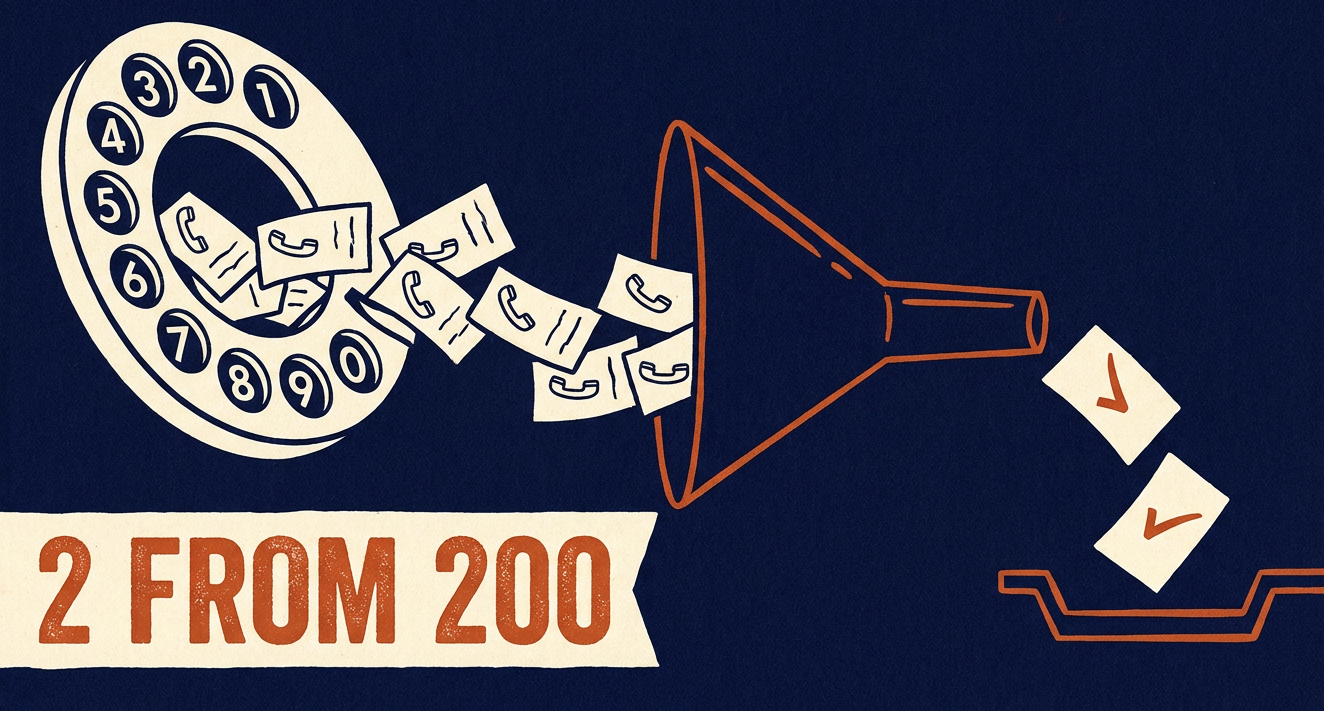
A two-person team made 200 cold calls over two weeks pitching a partner program — agencies bring a client, the poster handles setup and support, and the agency keeps 75–85% of first-sale profit. Twenty said "send it to my email," only 5–6 opened or replied, and two weeks later just two conversations are alive; the first two promising leads faded on budget and cold feet. The comments section supplies the calibration: "send me a demo" is a polite no roughly 80% of the time, cold calling yields a real pitch 1–3% of the time with maybe 1 in 5–10 of those converting, so the real funnel here is 200 dials → ~4 interested → 2 conversations, which is normal. The best fixes in the thread: book the 15-minute call while the prospect is still on the line, qualify by asking which of their own clients they'd actually bring this to, and call each name five times before judging the pitch. One more thing — an 85% profit share is so generous it reads suspicious, and dropping to 50–60% might remove more friction than it costs.
Source: r/sales — u/NickCrosss
Key Takeaways:
- The funnel is uglier than the top line: 200 dials by two people over two weeks produced ~20 'send me a demo' requests (1 in 10), but only 5-6 opened or replied, leaving 2 live conversations. Commenters note that 'send it to my email' is a polite no ~80% of the time, and benchmark cold calls at 1-3% yielding a real pitch with just 1 in 5-10 of those converting — count actual interest, not email promises.
- Stop accepting email as the next step: book the 15-minute call while the prospect is still on the line or assume it didn't happen — only 5-6 of the 20 promised emails were ever opened or replied to, and mailing a proposal without a booked follow-up forfeits your leverage.
- Treat 'too expensive' as a failed value demo, not a pricing problem: the prospect had already tested the product and said 'looks good, works well,' so ask what he expected to see and didn't — that single call teaches more than the other 198.
- Qualify before sending anything: ask the prospect which of their own clients they'd actually bring this to — if they can't name one, they were never a real yes. The same logic applies to your caller's comp: paying per meeting set incentivizes unqualified meetings, so tie pay to qualified meetings instead.
- Two structural fixes before rewriting the pitch: 200 names is too small a sample — call each name 5 times, email 5 times, and connect on LinkedIn before judging the copy; and a 75-85% profit share on the first sale reads so generous that agencies suspect the offer, so consider dropping to 50-60% to remove the suspicion.
Get the signal. Skip the noise.
AI sales tool verdicts, GTM playbooks, and market intelligence -- curated weekly for founders and revenue teams.