October 9, 2026
Your AI Is Faster. Is Your GTM Better?
Count the cleanup, fix the workflow, and give buyers a useful next step.
Congratulations: your AI can make more work faster. Before you order another dashboard, count the cleanup bill, rebuild sales capacity from actual bookings, and ask what your buyer needs next. This week’s practical test: can your system explain the result—or just produce another touch?
Stop Mistaking Speed for ROI
Count the cleanup and usage bill, then build a capacity plan from what sellers actually produce.
Who’s Really Paying for Your Marketing’s AI Efficiency?
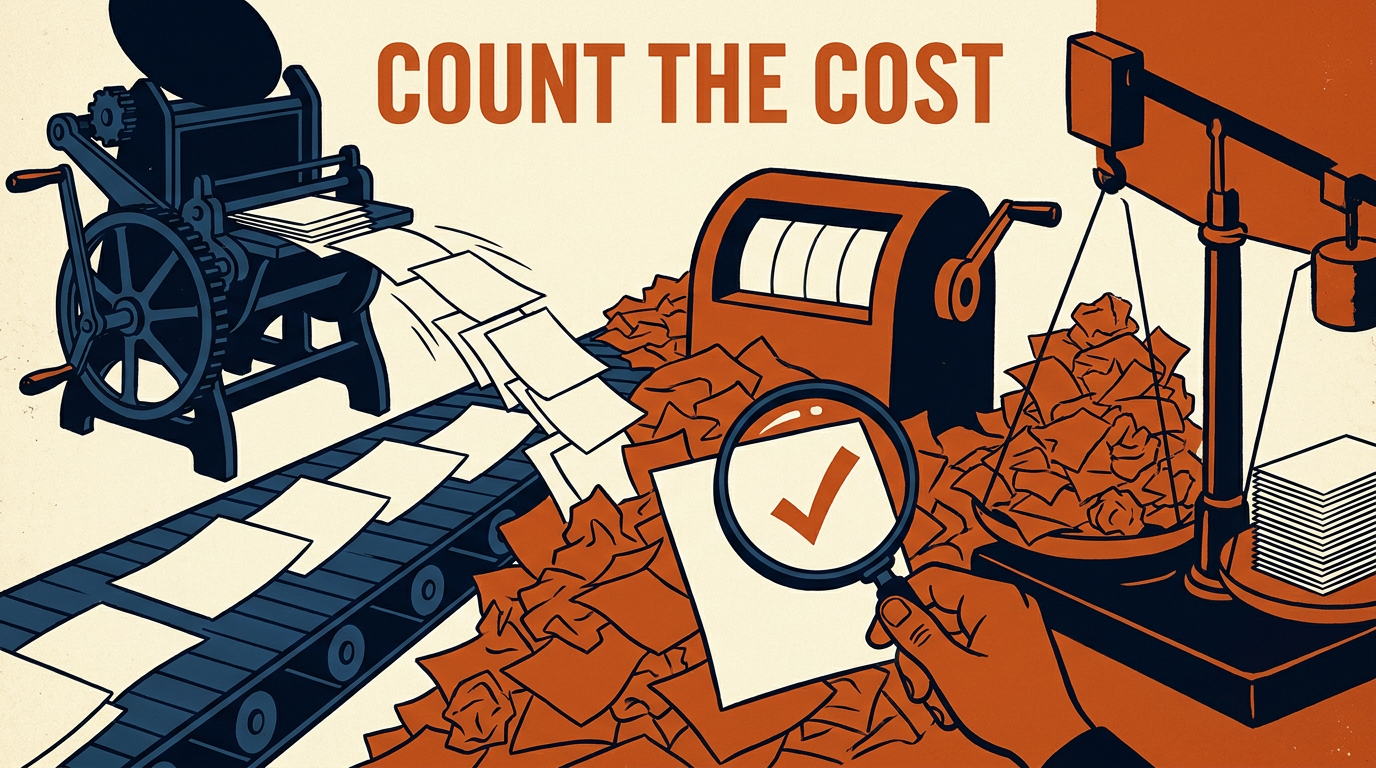
CMI’s research preview credits AI with speed far more often than better results: 78% cite speed, while 12% cite performance improvement. Robert Rose’s useful move is to put review and rework hours beside every throughput metric, then ask leaders and the team the same questions about quality and workload. Faster drafting can shift the bill into cleanup, audience trust and skills nobody develops. Audit the whole process before calling the saved minutes ROI.
Source: Content Marketing Institute
Inference Is the Most Important Market in Software
An AI subscription can carry a consumption bill that grows faster than the seat fee. Tomasz Tunguz explains what that does to seller compensation, forecasting, gross margins and acquisition payback; customers supplying their own model access change the revenue equation again. His market-size numbers are forecasts. The operating takeaway is concrete: model usage costs and customer budget limits before importing the economics of a conventional SaaS contract.
Source: Tomasz Tunguz
Sales Capacity Planning: Start With Productivity, Not Quotas
Dividing a board target by quota does not tell you how many sellers can deliver it. RevOps Co-op starts with trailing closed bookings per full-time seller, then splits the model by segment, region and tenure. Add actual ramp curves, departures, seasonal working time and fully loaded costs before comparing capacity with the target. Only then set quotas and work backward to required pipeline. Bring finance the assumptions that must change to close the gap.
Source: RevOps Co-op
Give the System an Owner and a Business Case
Shared workflows need visible failures, a person who fixes them, and a reason to deserve the budget.
Against the Personal Agents Theory of Everything
When everyone maintains a private agent, useful fixes stay private too. Nathan Baschez proposes shared systems for recurring tasks, with a visible queue, an owner who inspects failures, maintained instructions and a checklist for judging results. That gives a team one place to improve the work instead of repeatedly rebuilding personal setups. His fivefold learning example is illustrative, not a measured productivity gain; the shared feedback loop is the point.
Source: The Leverage / Nathan Baschez
Scaling Sales Teams in the Age of AI with Dini Mehta
Before buying more automation, map where sellers actually spend their time. Dini Mehta would automate research, enrichment and CRM maintenance, then return that time to discovery, stakeholder decisions and trust. She also cautions that spectacular AI revenue growth may still be spending its first experimental budget, with renewals untested. Choose a workflow from the audit and stick with it long enough to learn; a shopping habit is not an operating strategy.
Source: Grow & Tell / Dock
The Business Case For SEO Is Changing; Budget Justifications Should Too
Calling the same work GEO does not make it a better investment. Carolyn Shelby splits search spending into revenue growth, revenue protection, shared infrastructure and experiments that reduce uncertainty. Each needs a different financial test, and each competes with other uses of the budget. Define the decision an AI discovery experiment will change before funding it; citations alone cannot prove revenue impact. Her $1.2 million allocation is an illustration, not a recommended spending ratio.
Source: Search Engine Journal
Interpret the Buyer Before the Next Touch
An activity signal is a clue. Turn it into context that helps the buying group make its next decision.
More buyer signals won’t tell you what buyers need next
Three pricing-page visits can mean purchase intent, budget planning or a competitor comparison. Tanya Thorson’s argument is that a funnel stage describes your process without explaining the buyer’s decision. Ask whether the next useful step is education, proof, comparison, consensus or pricing clarity, and carry that context between marketing and sales. The practical stack test is whether it preserves understanding across channels, rather than merely triggering touch number four.
Source: MarTech
What Your Analyst Knows That ChatGPT Doesn’t
Use AI to prepare the feature comparisons; spend analyst time on the questions public evidence cannot settle. Matt Heinz makes the case for experienced judgment built from category history and live buyer conversations, then suggests asking about emerging risks and what would change an analyst’s view. Recognized coverage can still matter in enterprise procurement. An independent adviser may help you compete, but brings a different network and role. Buy the insight your decision needs.
Source: Heinz Marketing
Cheaper production makes campaign counts a weaker claim of progress. Keith Turco separates clicks, downloads and citations from buying-group confidence, then argues that channels should learn from one another: an event question shapes content, a customer conversation supplies proof, and stakeholder engagement informs the next interaction. Use community language to sharpen sales conversations. Increasing the number of measurable touches does not establish that any of them helped a decision.
Source: B2BMX Insights
Earn Attention Without Borrowing Trust
Answer real questions, test creative ideas, and make sure the expertise behind your content exists.
Creating Helpful, Reliable, People-First Content
Google’s refreshed guidance explicitly treats invented experts, false credentials and AI headshots used to fake human authorship as deception. Its broader test is whether the work adds original effort, accurate information and a satisfying answer for the intended reader. Audit bylines and the evidence behind your claims before scaling production. This is updated content-quality guidance, not a newly announced ranking switch; raters do not directly decide where your pages rank.
Source: Google Search Central
What Is the For You Page? How TikTok’s FYP Works in 2026
Foundation’s updated guide offers a useful B2B routine for recommendation feeds: take one question from a sales call or support ticket, make the topic clear immediately, cut the skippable parts and reuse ideas that earn attention. Follower counts and #fyp tags offer no guaranteed reach. Comments can feed the next piece of content and sharpen your messaging. Treat distribution as a repeatable learning process while keeping the risk of depending on one changing channel in view.
Source: Foundation
Here’s what the most-saved emails tell us about Q3 2026.
Really Good Emails compared its most-collected Q3 messages with hundreds of others using predefined design characteristics. Playful styling, retro treatments and welcome emails stood out; minimalist layouts appeared less often than expected. Those are creative hypotheses for your next test, not a conversion forecast. The authors acknowledge repeated brands and overlapping categories, and designer saves measure inspiration. Borrow an idea, then judge it against your own audience’s response.
Source: Really Good Emails
Community Spotlight
Two models agreeing is not an accuracy check
A practitioner used LLMs to label roughly 1,000 local-business websites, then asked another model to check the results. The catch: the rules looked for booking links and buttons, missing invitations written as plain text beside phone numbers. A separate review found those invitations on 178 of 435 reread sites. Model agreement had not established that the labels captured the intended behavior.
The comments get usefully specific: a sample balanced across label combinations can uncover failure modes while distorting overall error rates unless weighted correctly. The author acknowledges that hard cases and unequal cell frequencies weakened the estimate, and accepts a manually labeled random sample for the next run. Another model can flag disagreements; someone still needs to check whether the labeling rules themselves make sense.
Source: r/SalesOperations
Key insight: Before enriched data drives outreach, validate both the labeling rules and a representative sample against human judgments.
Key Takeaways:
- Plain-text booking invitations slipped past rules focused on links and buttons.
- The author reports finding missed invitations on 178 of 435 reread sites.
- Models can share blind spots even when the second never saw the first results.
- Balanced label-combination samples need population weighting to estimate overall rates.
- The author plans a manually labeled random sample and checks for booking-widget scripts.
More from the Community
Price the workflow before selling the AI dream
A seller describes customers layering AI onto messy systems, then retreating when usage bills arrive. Commenters add stories of exhausted credits and expensive receptionist minutes, while others defend AI’s usefulness; the practical suggestion is to start with one workflow and a measurable cost or speed baseline.
Source: r/sales
Human copy still needs a reason to matter
A founder reports more meetings after returning to handwritten outbound while keeping AI for prep and CRM admin. Replies challenge the explanation: bad targeting and saturated inboxes can sink human copy too, so test relevance and context alongside who writes the message.
Source: r/sales
A cloned sales room can leak your negotiating notes
An AE copied an old sales room and accidentally exposed deal scores, champion doubts and pricing strategy to a prospect. Commenters suggest a blank external template, separate internal workspaces and a buyer-view check before sharing, with a second reviewer as an extra check.
Source: r/SalesOperations
Get the signal. Skip the noise.
AI sales tool verdicts, GTM playbooks, and market intelligence -- curated weekly for founders and revenue teams.