October 16, 2026
Your Reply Rate Is Not Your Pipeline
Reply-rate math, buyer-shaped signals and the unglamorous work that makes AI sales systems useful.
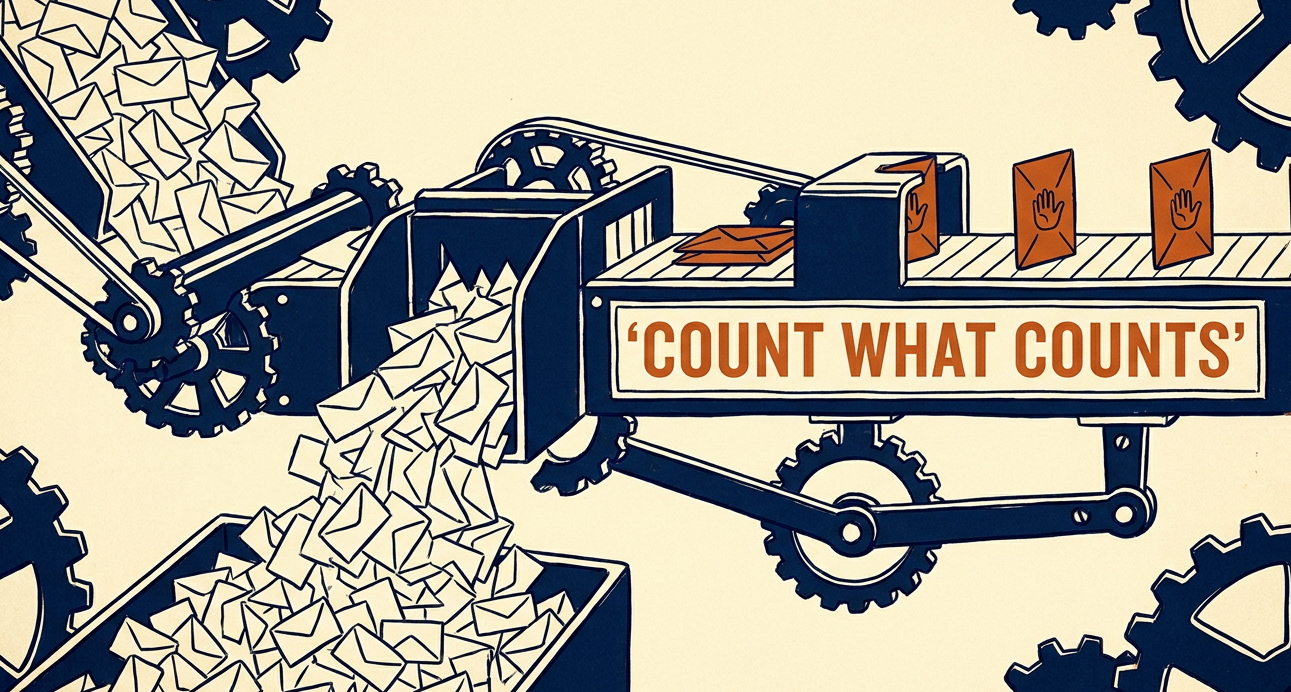
Your reply-rate dashboard looks lovely. Now ask how many replies meant interest. This week: a 7%-to-1.7% reality check, buyer-shaped signals, and agents that learn when an API stops answering.
Measure what moves the buyer
Replies, channel adoption and form fills each tell part of the story. Follow them through to interest, influence and pipeline.
What's working in B2B GTM in 2026
Cold outbound is oversaturated; relationships still do the heavy lifting. Kyle Poyar and Maja Voje surveyed 300 GTM leaders and found networks and intimate events strongest, while 39% now call AI search a core channel. The practical signal plays are familiar: champion moves, closed-lost reactivation and high-value site visits. Pick a repeatable motion and connect your context before buying another tool; this is self-reported channel performance, not a causal ROI trial.
Source: Growth Unhinged
87,015 cold emails: replies are not interest
A healthy reply rate can flatter a weak campaign. Across 87,015 emails in Konsyg-managed campaigns, 7.0% generated a response but just 1.7% registered interest. Track those separately, then follow qualified conversations through to meetings and opportunities. This is the agency's own campaign sample, not a universal benchmark or proof its service beats alternatives. Use the gap to audit your funnel before celebrating another dashboard full of replies.
Source: Konsyg
Content teams count leads while buyers count trust
AIM B2B’s survey of 152 leaders exposes a measurement mismatch: 64% of organizations judge content by leads, while only 22% track changed perceptions, preferences or decisions. Yet 71% of respondents say content prompted a connection. For an AI-scaled content engine, add a measure of buyer confidence alongside form fills. The survey is exploratory and concentrated in Japan and Asia-Pacific; its findings are directional, not a global conversion benchmark.
Source: AIM B2B
Build signals around real buying decisions
Start with the people, constraints and switching costs. Then decide which signals deserve a response.
Choose the buying group before choosing the signal
More signals will not rescue a vague picture of the buyer. LeadFabric’s Zoe De Preter argues for mapping one buying group through customer interviews, lost-deal conversations and sales calls before wiring up alerts. Learn what finance, IT, procurement and users each need to see; then choose the behaviors worth tracking. The practical move is one segment, one programme and a measure of preference alongside engagement, so a busy account is not mistaken for a convinced one.
Source: LeadFabric
Want to Steal a Customer From a Competitor? Ask Them What It Would Really Take
Your feature grid does not pay for a buyer's migration, retraining or political risk. Jason Lemkin recommends asking 20 competitor accounts what single problem would make switching worthwhile, then separating solvable pain from bespoke work and price-shopping. Follow the answer with a tailored migration plan, switching-specific collateral and compensation that rewards difficult takeaways. The useful artifact is a concrete switch case; the article's punchy percentages are rhetoric, not research.
Source: SaaStr
One buyer constraint changed the AI shortlist in 21 of 30 categories
Your bare category prompt is a poor stand-in for a buyer. Empact tested 30 software categories across ChatGPT and Google AI Mode; adding one buyer constraint changed ChatGPT’s first-named brand in 21 of 30 categories. The useful audit pairs generic prompts with real constraints from sales calls, then checks the gaps. This is a one-evening, US-only sample, so treat the result as a prompt-design lesson rather than a permanent ranking law.
Source: Empact Partners
Make the workflow survive contact with reality
Useful automation needs sourced inputs, working APIs and someone with authority to resolve the awkward handoff.
Build the prospecting loop before the AI-written email
An AI-written opener is the middle of the system, not the starting point. Growth Today’s workflow begins with explicit account criteria and exclusions, verifies data, separates fit from timing, and gives each routed record an owner. Research, signals, decisions and outcomes then return to the CRM. The useful constraint: keep source URLs and timestamps beside the facts, and enforce suppression and ownership rules before activation rather than asking the model to improvise them.
Source: Growth Today
Your agent needs to know which APIs still work
The best semantic match is useless when its API is down. Texas Tech researchers combine relevance with recent execution feedback; under simulated 30% outages, their system selected failing APIs 2.9% of the time versus 86.2% for one static retriever. For a sales workflow, the design lesson is to feed errors and timeouts back into routing. That application is our inference: the paper tests retrieval, and live deployment validation remains future work.
Source: arXiv
Marketing has outgrown the organization built to run it
Your outreach agent can inherit the same broken handoffs as your team, only faster. Gareth Chilton argues that connected systems still sit inside organizations with fragmented authority. Before agents act across marketing, sales and service, define who controls the data, approves decisions and owns escalation. Specialist teams remain useful; the missing piece is shared decision rights across their boundaries. An API connects systems, but it does not settle who gets to decide.
Source: MarTech
Put evidence and expertise back in the loop
Trustworthy content, credible buyer research and practical AI skills all depend on showing how the work was done.
Why AI Disclosure Won’t Build Trust in Your Content (and What Will)
An 'AI-assisted' label tells a buyer very little about whether a claim deserves belief. Robert Rose proposes three lines in every content brief: name the expert, identify the real experience, and trace each number to a primary source. Start by exposing the gaps, then decide who can stop publication and fund the interviews and research. Let AI flag unsupported claims before a human signs off. Provenance is an operating process, not a disclaimer pasted onto weak content.
Source: Content Marketing Institute
AI in B2B research: Beyond the hype, where’s the real value?
A synthetic buyer can sound convincing while quietly recycling yesterday’s assumptions. Lynsey Showman’s conference analysis asks where fresh human evidence enters the loop, how synthetic audiences are validated and whether maintaining them makes commercial sense. The near-term win may be simpler: help teams use research they already own, with its caveats intact. Benchmark AI against the method it would actually replace, then measure research quality, decision speed and cost.
Source: Adience
Marketing hiring trends 2026: The skills employers want in Q3
CXL's Q3 sample of 878 US marketing job posts puts AI requirements at 40%, versus 15% in its Q1 sample; 54% now mention AI and 35% mention automation. The shift is toward building repeatable workflows, and it reaches senior and lead roles as well as execution jobs. For hiring, ask candidates to demonstrate a system they built and the result it changed. For your own portfolio, show the workflow. These are quarterly samples, not a census or proof of job displacement.
Source: CXL
Community Spotlight
Your champion tracker is paying to discover nothing changed
A RevOps team built its own champion job-change tracker, then found the expensive part: repeatedly enriching thousands of people who had not moved. They report catching more changes, but the credit bill now has them questioning overlapping contracts. A useful trigger can still have an expensive detection process.
The comments offer different ways to shrink it: track only proven champions, skip recently checked records, or use change notifications instead of full-list sweeps. The catch is obtaining a reliable change signal in the first place. Nobody supplies a verified cost comparison; treat the architectures as options to test, not promised savings.
Source: r/SalesOperations
Key insight: Price the work required to detect a useful signal, including unchanged records, before scaling the workflow.
Key Takeaways:
- The original team reports finding more champion moves, while burning credits rechecking thousands of unchanged contacts.
- One commenter says they cut their tracking pool to people involved in closed deals; that trades coverage for lower checking costs.
- Another proposes using recent meetings and enrichment timestamps to exclude records from the next refresh.
- Commenters suggest pushed change notifications and CRM tasks, alongside keeping the last known company and title.
- Reliable change detection remains the unresolved input: vendor recommendations and claimed savings are anecdotal.
More from the Community
24 touches in 10 days: automate the restraint, too
A home-improvement rep describes 14 calls, seven texts and three emails per lead in ten days, mostly handled manually. Many commenters say they would block the company; one suggests an explicit offer to stop contact. Before automating the admin, test the cadence and build a clear exit.
Source: r/sales
A transcript is only the first step
A rep asks why CRM fields, tasks and handoffs still need work after a call is transcribed. Replies differ: one finds draft follow-ups easier, another says incorrect automatic updates create more cleanup. A suggested middle path is proposed field changes and tasks for approval.
Source: r/salesdevelopment
AI call screeners: a gatekeeper, not a verdict
An agency owner predicts AI receptionists will kill cold calling; commenters dispute the extrapolation and say industry still matters. One rep treats the screener like a short written message: name, reason, email follow-up. Others question whether anyone gets through consistently, so test it in your segment.
Source: r/sales
Get the signal. Skip the noise.
AI sales tool verdicts, GTM playbooks, and market intelligence -- curated weekly for founders and revenue teams.